
QUICK ANSWER: Five trends are shaping UAE glass-and-aluminium facades right now: thermally broken aluminium framing to cut heat transfer, smart/active glass that responds to conditions, CNC-enabled complex geometry at near-standard cost, stricter fire-safety compartmentation at spandrel junctions, and a shift toward sourcing glass and aluminium from one accountable supplier instead of two separate vendors.
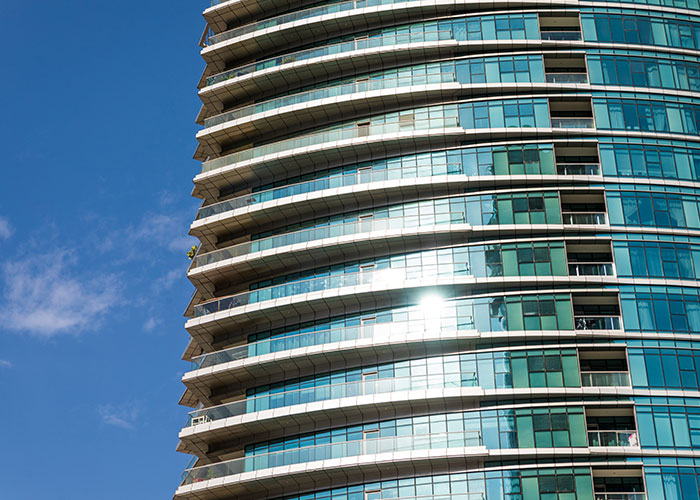
From the Museum of the Future’s free-form stainless mesh to The Opus’s torus-shaped glass void, the UAE has become a proving ground for facade design that would have been impractical, or impossibly expensive, a decade ago. Behind the architecture, five trends in glass and aluminium technology are doing the practical work: better insulated framing, smarter glass, precision-cut complex shapes, tighter fire safety requirements, and a shift toward single-source glass-and-aluminium suppliers. Here’s what each one means for your next project.
Thermal-Break Aluminium: Why Frame Design Matters as Much as Glass
Aluminium conducts heat extremely well, which is useful in a kettle and a problem in a window frame. A standard aluminium profile creates a continuous metal path from the hot exterior straight through to the interior frame — thermal breaks interrupt that path with a low-conductivity material (typically polyamide) set into the profile, cutting how much heat the frame itself transfers.
In a climate where exterior temperatures regularly exceed 40°C, frame performance isn’t a minor detail — a thermally broken frame paired with the right glass is what lets a whole-building energy model show meaningfully lower HVAC loads, rather than just better-performing glass fighting a leaky frame.
Thermally Broken vs. Standard Aluminium Framing
| Standard aluminium frame | Thermally broken frame | |
|---|---|---|
| Heat path | Continuous metal path, exterior to interior | Interrupted by a low-conductivity (polyamide) strip |
| Heat transfer | High — frame conducts heat readily | Significantly reduced |
| Best suited to | Low-exposure, secondary openings | Primary facades, large glazed areas, hot climates |
| UAE code fit | May struggle to meet Estidama/Al Sa'fat targets on large facades | Supports U-value targets on primary glazing |
Smart Glass and Active Façades: From Novelty to Mainstream
Facade engineers are increasingly talking about buildings that respond to conditions rather than just resist them. Industry commentary points to a few converging shifts: machine-learning tools starting to assist facade design and optimization, smart glass technologies (glass that can change tint or opacity), and “active” facades that adjust to sun position and temperature rather than relying purely on static shading.
Adoption in the region is still early and project-dependent — these technologies tend to appear first on landmark and institutional buildings before becoming standard specification — but they’re worth tracking for any project with a long design horizon or a strong sustainability brief.
CNC Precision and the Rise of Complex Geometry
Free-form facades used to carry a heavy cost penalty, because every non-repeating panel had to be custom-made by hand. CNC (computer-numerically-controlled) cutting and edge-working equipment has changed that math: complex, non-repeating glass shapes are now practical at a cost much closer to standard rectangular panels, because the precision and repeatability come from the machine, not from manual fabrication.
This matters beyond landmark architecture — it also means custom-shaped glass for staircases, skylights, feature walls and bespoke storefronts is far more accessible than it used to be, for projects of any scale.
Fire Safety and Compartmentation in Glazed Façades
As glazed facades have gotten larger and more complex, fire safety at the junctions between floors has become a bigger focus. The area behind a spandrel panel — the opaque section of glazing that conceals the floor slab — is a recognized weak point for fire spread between floors if it isn’t properly compartmentalized and tested.
The UAE Fire and Life Safety Code sets the baseline requirements here, and specifying glazing and spandrel systems with proper fire-tested compartmentation (rather than treating it as a glazing afterthought) is increasingly a nonnegotiable part of facade design on mid- and high-rise projects.
The Rise of the Single-Source Glass & Aluminium Supplier
Most facade packages split naturally into two trades — glass and aluminium — which historically meant two suppliers, two lead times, and two parties to coordinate when a detail changes mid-project. The trend on UAE projects is toward consolidating that into a single supplier who processes the glass and fabricates the matching aluminium framing in-house, so one party is accountable for how the two fit together, from curtain walling and storefronts to windows, doors and cladding.
For contractors managing tight schedules, that coordination advantage often matters as much as the component pricing.
5 UAE Facade Trends at a Glance
| Trend | What it means | Why it matters |
|---|---|---|
| Thermal-break aluminium | Low-conductivity strip interrupts heat flow through the frame | Lowers HVAC load in 40°C+ climates |
| Smart / active glass | Glass or facade elements that respond to sun and temperature | Early-stage; strongest on landmark/longhorizon projects |
| CNC-enabled geometry | Machine-cut complex shapes at nearstandard cost | Free-form design without the old cost penalty |
| Fire-safe compartmentation | Tested spandrel/glazing systems that resist fire spread | Required for UAE Fire and Life Safety Code compliance |
| Single-source supply | One supplier for both glass and aluminium framing | One point of accountability, faster coordination |
FAQ
What is a thermal break in aluminium framing?
A thermal break is a strip of low-conductivity material (usually polyamide) set into an aluminium profile to
interrupt the continuous metal path between the exterior and interior faces of a frame, reducing how much heat the frame itself conducts.
Is smart glass commercially viable in the UAE yet?
It’s used on select landmark and institutional projects, but widespread adoption is still developing. It’s worth evaluating for projects with long design timelines or strong sustainability targets, alongside more established options like Low-E and solar control glass.
Why does facade fire safety matter for glazing specification?
Spandrel areas (the opaque sections of a glazed facade that hide floor slabs) are a recognized point of fire-spread risk between floors if not properly compartmentalized. UAE Fire and Life Safety Code requirements make tested, compliant spandrel and glazing systems essential on mid- and high-rise projects.
What’s the advantage of sourcing glass and aluminium from one supplier?
A single supplier who processes the glass and fabricates the aluminium framing in-house is accountable for how the two systems fit together, which reduces coordination overhead and the risk of mismatched details between separately sourced components.
Does Noor Asadi fabricate custom or complex glass and aluminium shapes?
Yes. Noor Asadi Glass & Aluminum Factory L.L.C. uses CNC and manual cutting alongside edge-polishing, beveling and grinding to produce custom and complex glass shapes, and fabricates matching aluminium framing in-house at its Mussafah, Abu Dhabi factory.
Conclusion
None of these five trends are standalone — a thermally broken frame still needs the right glass, and a complex CNCcut shape still needs fire-safe detailing at every junction. Working with a single glass-and-aluminium partner who understands how they fit together is what keeps a facade on schedule and on spec.